When I assess a new property district, I do not start with the height of its towers or the value printed in the announcement. I start with a more practical question: who will use the place every day, and what will make them choose it over another location? That is the right starting point for a Dubai Creek Harbour investment after Emaar’s announcement of Dubai Square Business District. The proposal is not just about adding offices; it is about bringing work, homes, retail, hotels, parks and public transport into one connected destination.
Real Estate & Investment Analysis | Dubai, UAE | Updated 10 November 2026
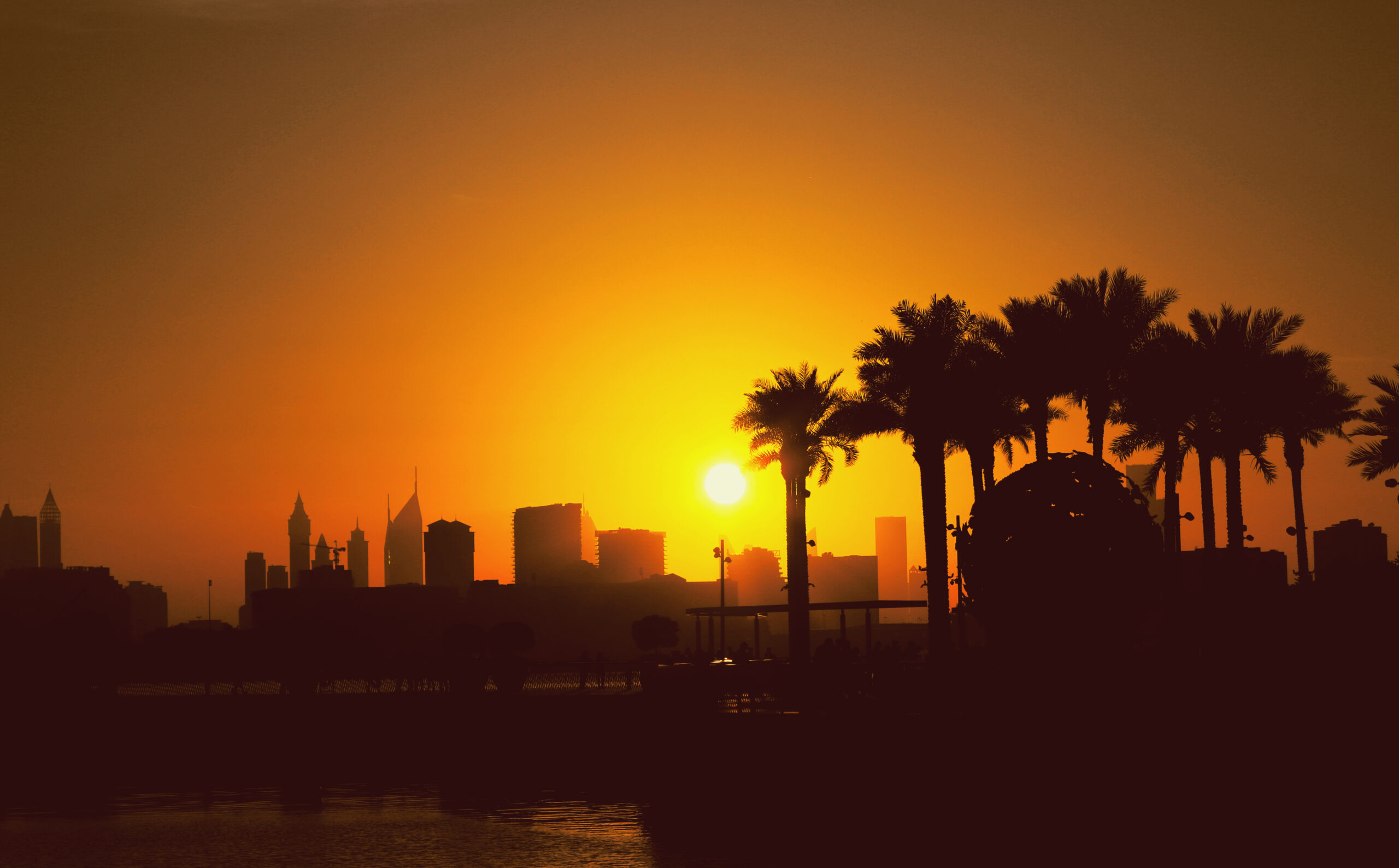
On 9 November 2026, Emaar announced a new commercial and office district beside Dubai Square, covering 300,000 square metres with a stated total development value of AED 12 billion. The number is substantial, but it is not an expected investor return and does not mean that the entire value relates to offices available for individual purchase. The difference between the development value of a district and the value of an asset an investor can actually buy is the first distinction to make. [1]
Dubai Creek Harbour investment: what Emaar’s announcement changes
Emaar describes Dubai Square Business District as 300,000 sq m of commercial and office space arranged around Dubai Square retail, four hotels and three urban parks. The announcement also refers to two metro stations on site and positions a new Dubai Creek Tower as a future landmark for the destination. These are the elements set out in the announcement. It does not, however, provide enough detail on the office handover schedule, the split between office and retail space, individual sale prices, achievable rents or the proportion of office space that will be available for individual ownership. [1]
That distinction matters. We know the proposed area and the announced development value. We do not yet know the price per square foot for a specific office, the rent an owner can collect, or the ownership and leasing model for the space. I would not treat AED 12 billion as evidence of investment profitability. It is a measure of development scale and ambition, not a ready-made investment case.
The wider community is what could support demand
Emaar says the business district sits within a planned community intended for around 200,000 residents, with more than 200 residential towers and 75,500 homes. The announcement also lists planned community infrastructure: 7 schools, 14 nurseries, 2 hospitals, 25 clinics, 11 mosques and more than 70 community shops. These are masterplan figures and planned capacity; they should not be read as the number of residents living there today or proof that every facility is already open. [1]
For the wider masterplan, Emaar refers to 15 parks, four green corridors and open space equal to 13% of the plan, together with a 4.5 km waterfront promenade and a 600 m urban beach. Amenities of this kind can improve the district’s appeal, but they create economic value only when they are delivered, maintained, accessible and used. A landscaped park shown on a masterplan is not yet a reason to pay a premium for a property beside it.
Dubai Creek Harbour over five years: from construction to a more complete district
2021: formation and infrastructure works
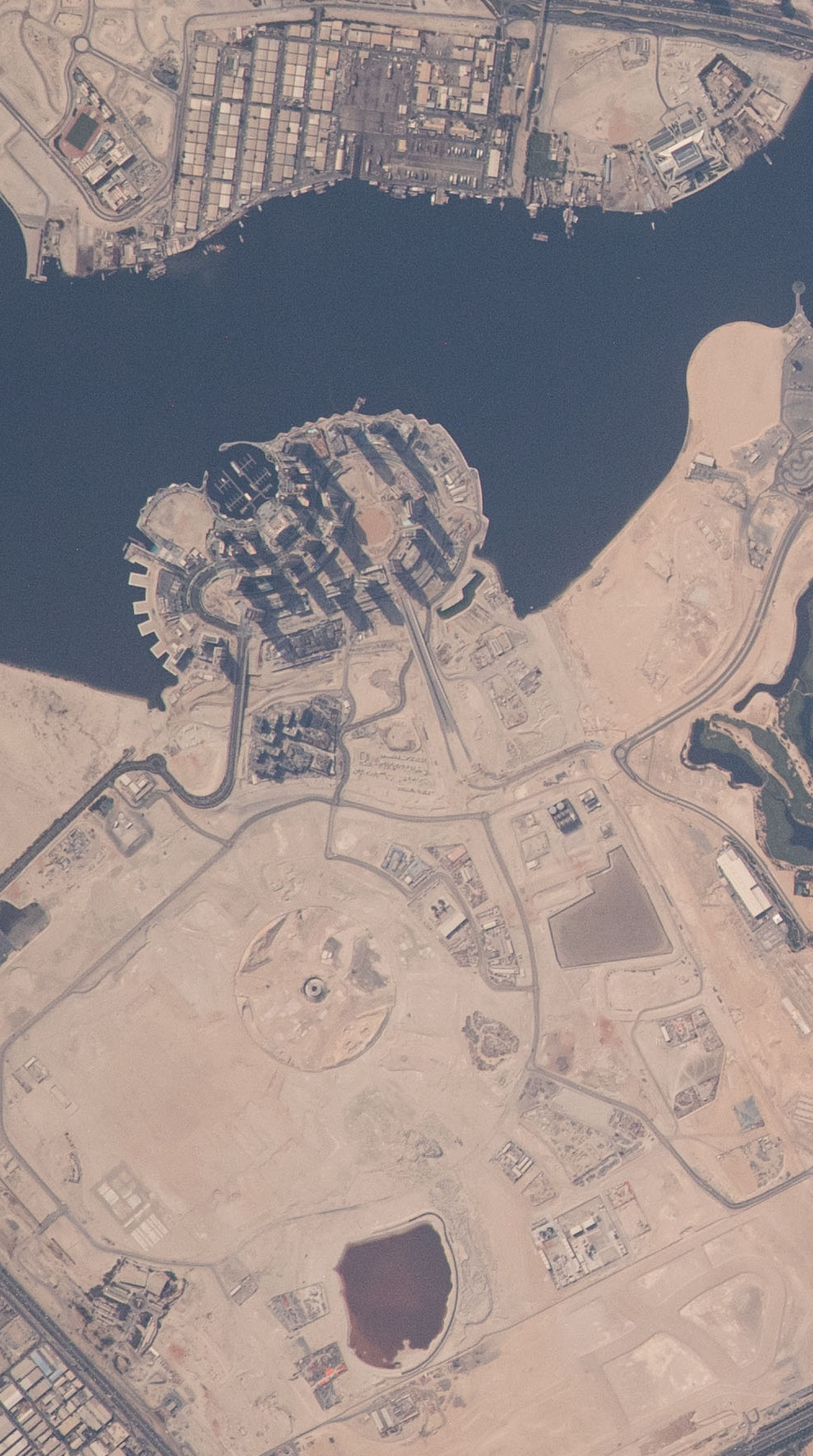
The International Space Station photograph dated 26 May 2021 shows Dubai Creek Harbour at a stage when construction activity, the island district and the marina were clearly visible from above. Its value here is as a dated point of comparison, not as a complete map of today’s development boundaries. Set beside the later waterfront photographs, it helps illustrate how the area has moved from dispersed construction sites towards a more recognisable waterfront community. [7]
The existing district: what can be confirmed
The photograph above is dated 18 January 2024. It is a documented visual reference for the waterfront and marina, not a November 2026 photograph. The current picture is better understood through Emaar’s latest announcement and its community information, which describes a developed waterfront setting with marina, promenade, restaurants and amenities, close to Ras Al Khor Wildlife Sanctuary and with access to Downtown Dubai and Dubai International Airport. [5]
2031: an illustrative scenario, not a delivery commitment
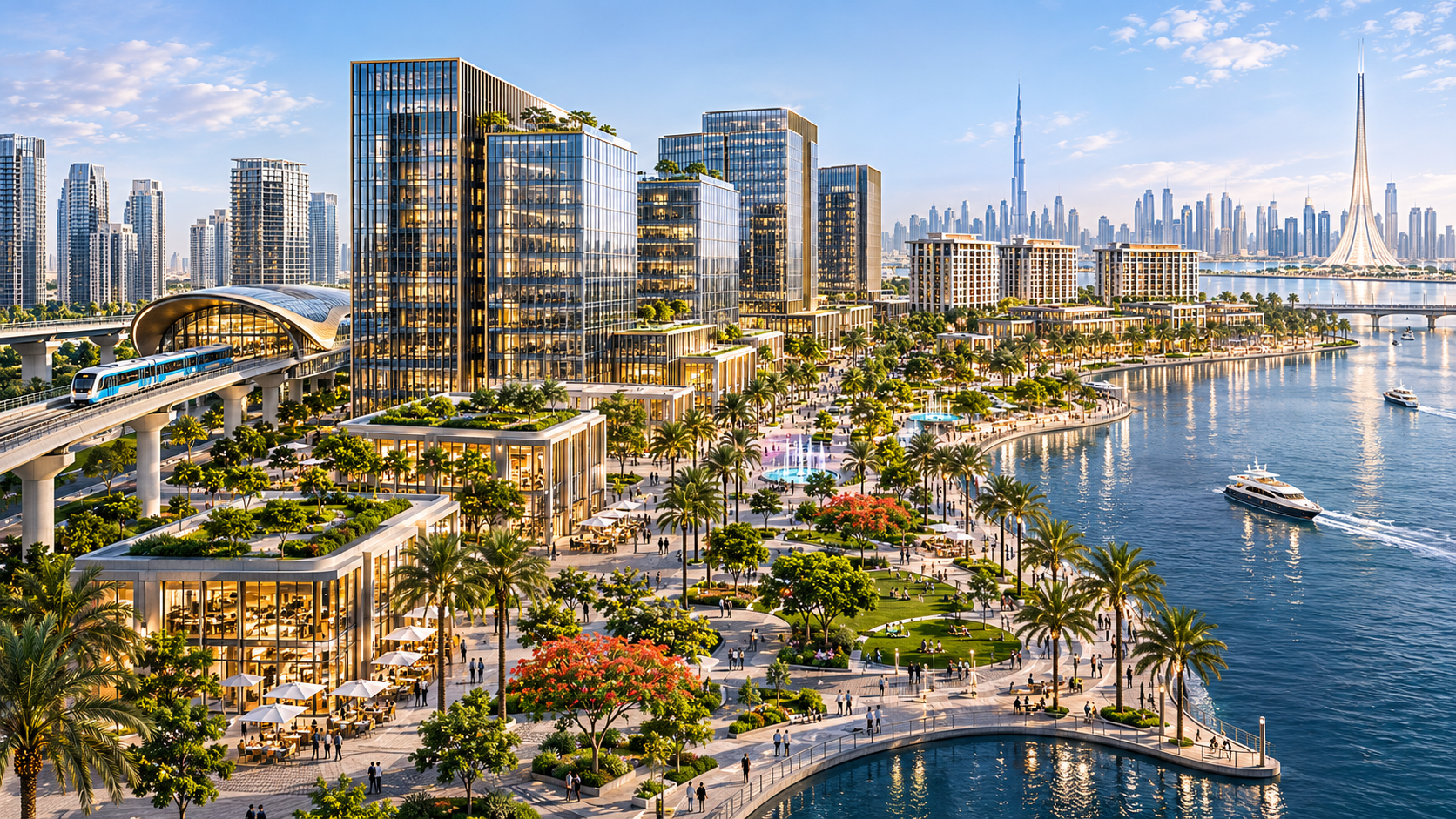
I use 2031 as a visual horizon because it falls after the RTA’s target year for the Blue Line and allows time for transport and amenities to influence the district if delivery proceeds as planned. Emaar’s 9 November 2026 announcement does not give a final handover date for the new office district. The image is therefore an AI-generated illustration of a possible urban scenario, not an approved Emaar rendering or a promise that the area will look this way by 2031.
The Blue Line: a demand catalyst, not a guaranteed return
Emaar says the business district will connect to two metro stations on site. Separately, the Roads and Transport Authority confirms that the Dubai Metro Blue Line will extend for 30 km and include 14 stations, with a major station at Dubai Creek Harbour. The route connects areas including Al Jaddaf, Dubai Festival City, Ras Al Khor, International City, Dubai Silicon Oasis, Academic City, Mirdif and Al Warqa. The published target completion year is 2029. [2][3]
The RTA forecasts 200,000 daily riders on the line in 2030 and 320,000 in 2040. Those are system-wide projections, not passenger forecasts for the Creek Harbour station alone. Also, Emaar’s reference to two stations within the business district should not be confused with the RTA’s Blue Line station information. Before buying a specific office or home, an investor should check the approved station plan, the exact entrance locations and the real walking route from the property. A station can be close on a map but inconvenient in daily use. [2]
The RTA announced the launch of primary tunnelling works for the Blue Line in May 2026. That is a meaningful construction milestone, but it does not remove the risk of delivery delays or a gap between the opening of transport and the operation of surrounding amenities. I would price the property on the benefits it has today, then treat the metro as a future catalyst whose timing still matters. [4]
Nearby areas that could benefit from the development
The benefit will not be evenly distributed. A property inside Dubai Creek Harbour, a neighbourhood served by a Blue Line station and an established business district connected mainly by road are not in the same position. The transport map should not be turned into a blanket prediction that every nearby property will rise in value.
Dubai Creek Harbour, Creek Island and Creek Beach: the closest catchment
These locations are closest to any increase in office employment, retail visits and hotel activity. More workers and visitors could support nearby residential demand, restaurants, services and hospitality. But the wider plan also includes a large residential pipeline. Demand may grow, while competing supply grows at the same time. A building with convenient access to the waterfront and daily amenities may perform differently from a similar unit that still depends on a car for every journey.
Al Jaddaf and Dubai Festival City: connectivity and a wider daily catchment
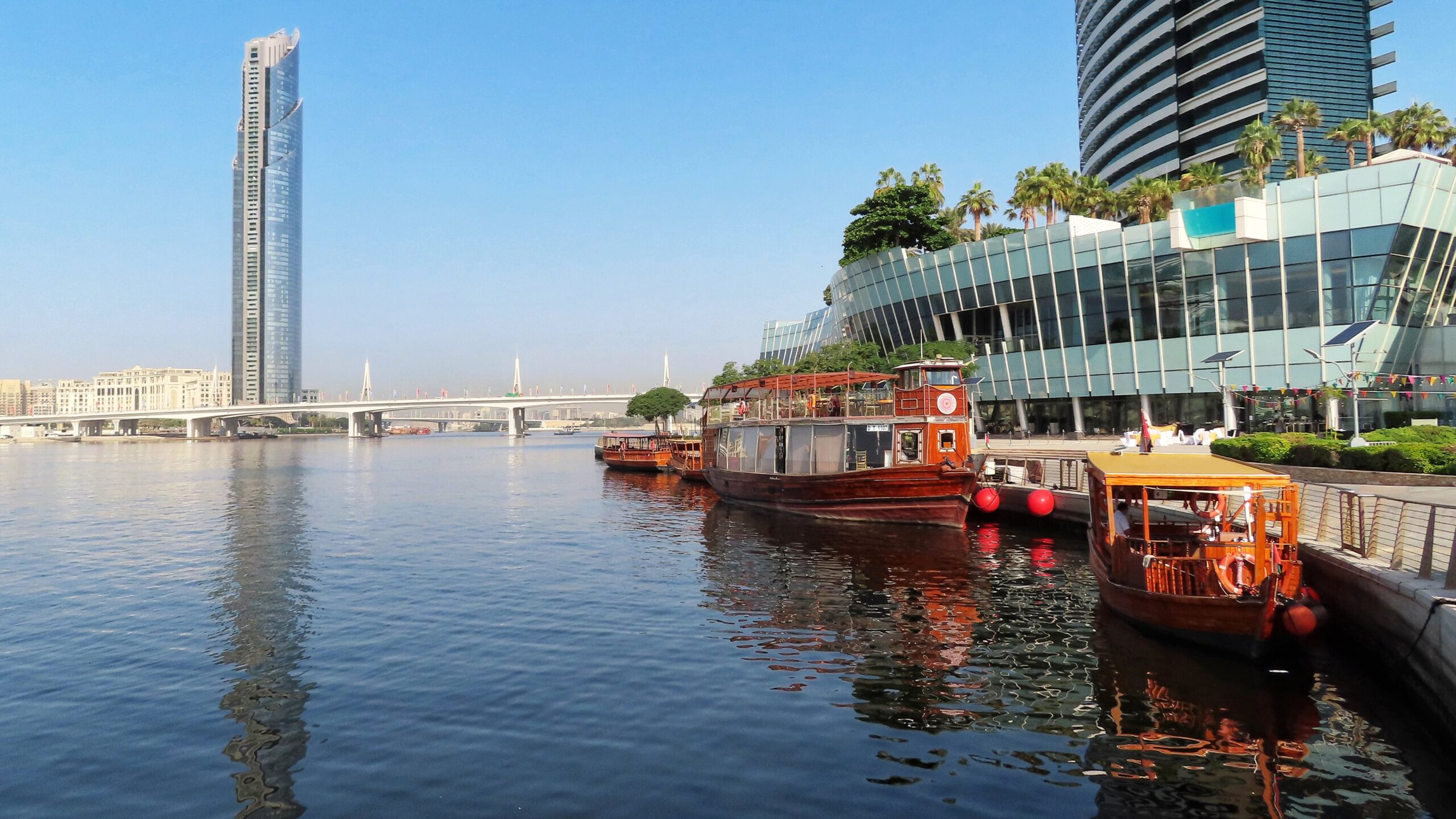
Al Jaddaf is important as a connection point to the existing metro network, while Dubai Festival City is on the announced Blue Line corridor and already has established retail and hospitality activity. Better connections with Creek Harbour could widen the potential employee and visitor catchment. It could also increase competition between retail, dining and office destinations; some spending may be redistributed rather than created from nothing. [2][3]
Ras Al Khor and the wildlife sanctuary: connectivity with environmental limits
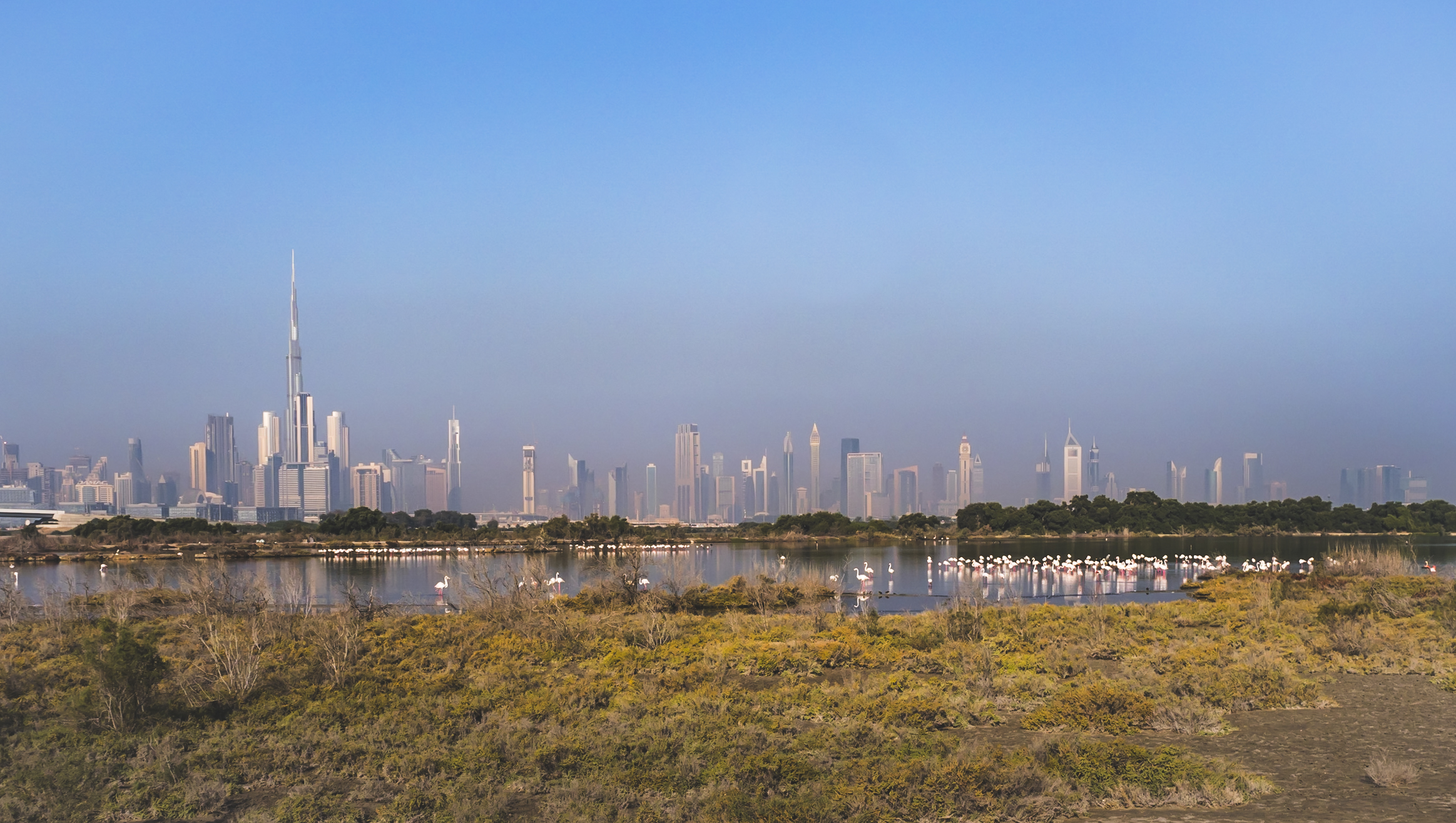
Commercial and industrial areas around Ras Al Khor may benefit from better road and metro access. The wildlife sanctuary itself is different: it is a protected wetland, not a reserve of land for real-estate expansion. Dubai Municipality lists its total area as 10.13 sq km, notes that it was declared a protected area in 1998 and that it became a Ramsar site in 2007. Its environmental role is part of the location’s value and must be protected, not treated as a development opportunity. [6]
International City, Dubai Silicon Oasis, Academic City, Mirdif and Al Warqa
These areas are not immediately adjacent to Dubai Square, but they sit within the wider catchment of the Blue Line. Better connections may give residents, students and employers more flexibility when choosing where to live, work or study. Any effect on property rents and values will still depend on the exact asset, its walking distance to a station, competing supply and local demand. [3]
Downtown Dubai and Business Bay: a more indirect relationship
Downtown Dubai and Business Bay remain accessible by road and may interact with Creek Harbour as another business and visitor destination. There is no evidence, however, that companies will automatically relocate from established districts or that property values there will rise simply because Dubai Square is announced. It is more realistic to view Creek Harbour as an additional business location that may complement Dubai’s existing centres.
Where could the investment upside emerge?
Homes close to jobs and amenities
If the business district attracts companies and tenants, it could create demand from employees, managers and business owners who prefer to live near work, public transport and daily services. Units with practical layouts, convenient access and manageable service charges may compete better than similar homes without a clear advantage. The planned 75,500-home residential base also means an investor needs to consider competition before paying a premium because a property is close to Dubai Square.
Offices: new demand, but also new supply
The announced 300,000 sq m of commercial and office space creates a new business product, but it is also a significant addition to the market’s future supply. Office performance will depend on the quality of the floorplates, flexibility of space, parking, digital infrastructure, service charges and the ability to secure tenants on sustainable leases—not simply on a Grade A label. Emaar’s announcement does not yet give enough detail to establish whether offices will be sold individually, retained as leased assets or offered through another structure. That must be understood before an investor builds a return model.
Retail, dining and daily services
Workers, hotel guests, residents and park visitors could create a different pattern of daily activity from a conventional shopping trip. That may support cafés, restaurants, healthcare and professional services. But two retail units in the same district can have very different prospects: one may sit on a clear pedestrian route, while another is on a secondary frontage with limited visibility. Footfall, entrance location, parking, operating costs and tenant mix matter more than proximity on a map.
Hotels and hospitality
Four hotels around the business district make hospitality part of Emaar’s vision, but they also introduce competition between operators. Returns from a hotel-related asset depend on the operator, management fees, revenue-sharing terms, seasonality, operating costs and any restrictions on personal use. A planned hotel count does not establish a future occupancy rate.
Capital appreciation
Some assets may become more attractive as parks, retail, the metro and other amenities move from drawings into operating services. But those future benefits may already be reflected in today’s asking prices. If an investor pays a high premium for infrastructure that has not yet opened, the district could improve without producing a satisfactory capital gain for that investor. The entry price remains as important as the quality of the development.
The risks I would price into the decision
- Delivery timing: the business-district announcement does not provide a detailed office handover schedule. Delays to the district, metro or amenities postpone demand formation.
- Competing supply: 75,500 planned homes may support a large community, but overlapping handovers could put pressure on rents.
- Entry price: paying today for every expected future benefit leaves little margin of safety.
- Vacancy and operating costs: asking rent is not collected rent; service charges, maintenance, management and vacant periods reduce cash flow.
- Real station access: a station shown on a masterplan does not guarantee a convenient walking route from a specific building.
- Resale liquidity: a sale may take time or require a discount, especially when competing units are being handed over.
- Ownership and use rights: investors must verify whether offices can be individually owned or leased and what restrictions apply.
Calculate the return before deciding whether the property is worth buying
I look at three measures when comparing a rental property. Gross yield compares potential annual rent with the purchase price. Vacancy-adjusted yield reflects the rent that may actually be collected after empty periods. Net operating yield then deducts annual operating expenses and divides the remaining income by total investment cost, including acquisition and setup costs. This is closer to the figure an investor needs when comparing deals, although it still excludes financing, tax and selling costs unless those are added to the model.
For illustration, assume a unit costs AED 2 million, could rent for AED 140,000 a year, has 5% vacancy, AED 30,000 in annual operating expenses and AED 100,000 in acquisition and setup costs. Gross yield is 7%. After vacancy, collected rent falls to AED 133,000. After operating costs, net operating income is AED 103,000, or approximately 4.90% of the total AED 2.1 million investment cost. This is an arithmetic example, not a published price or yield for a Dubai Square unit.
[mr_creek_investment_calculator lang=”en”]
Change the inputs to match the property you are considering. The Conservative, Base and Upside cases are sensitivity tests, not forecasts for Dubai Creek Harbour. Before relying on the result, include actual service charges, maintenance, insurance, management and a vacancy assumption that fits the unit type and location.
Questions I would want answered before committing
- How much of the announced space will actually be offered for sale, and how much will remain under developer ownership or be leased?
- What is the approved construction and handover schedule for the offices, hotels, parks and associated amenities?
- Where are the approved metro entrances relative to the building, and is the walking route direct and shaded?
- What are the achieved sale prices and collected rents for comparable properties in Creek Harbour and competing districts?
- What are the annual service charges and the owner’s costs when a tenant leaves?
- How much competing residential, office and hotel supply is due to be handed over during the same period?
Further reading
For a wider investment framework, see Dubai Real Estate Investment Outlook. Before making an offer, use the Dubai Property Buyer’s Guide and review what to verify in a developer’s track record. For context on competing office supply, read our review of Dubai’s expanding office market.
The investment case comes down to the asset and the entry price
Dubai Square could give Creek Harbour an important new economic role: a business district supported by a planned residential community, a growing transport network and a waterfront destination. That combination deserves attention. It does not make every property nearby a good investment.
The better purchase may not be the first unit released or the one with the most dramatic view. It is the asset with identifiable tenant demand, a location advantage that can be used every day, manageable ownership costs and a price that leaves room for delays or weaker-than-expected rent. The return should still make sense after vacancy and expenses—not just in the sales brochure.
Frequently asked questions about Dubai Square and Dubai Creek Harbour investment
Does the AED 12 billion value relate to offices alone?
No. It is the total development value announced for Dubai Square Business District. Emaar’s announcement does not state that the full amount is allocated to offices alone, and it is not an investor’s profit or expected return.
When is the Dubai Metro Blue Line expected to open?
The RTA’s published target for completing the Blue Line is 2029. That is the target for the transport project; it does not set the handover date for Dubai Square Business District or guarantee that every surrounding facility will open at the same time.
Will individual investors be able to buy offices in Dubai Square?
Emaar’s announcement does not yet set out the ownership or sales structure for the office space in enough detail. Investors should wait for the offering documents and verify title, usage and leasing rights before treating the offices as individually purchasable assets.
Has Emaar announced a guaranteed rental yield?
No verified rental yield is provided in the announcement. The return on an individual property will depend on its purchase price, rent actually collected, vacancy, service charges, maintenance and management costs.
Can land within Ras Al Khor Wildlife Sanctuary be developed?
The sanctuary is a protected natural wetland, not a reserve of land for real-estate development. Any potential benefit to nearby areas must be assessed alongside the sanctuary’s environmental and regulatory protections.
Disclaimer: This article is informational analysis, not a recommendation to buy or sell. Emaar’s figures describe an announced development and masterplan; RTA figures describe the transport project and system-wide forecasts. The example and calculator inputs are illustrative and must be replaced with verified transaction, rent and cost data for the property under review.
Sources and references
- Emaar Properties – Dubai Square Business District: The Address of Ambition, 9 November 2026. https://uae.emaar.com/en/press-release-listing/dubai-square-business-district-the-address-of-ambition
- Dubai Roads and Transport Authority – Dubai Metro Blue Line: route, stations and ongoing project status. https://www.rta.ae/wps/portal/rta/ae/home/news-and-media/AllProjects/ongoing-project-details/dubai-metro-blue-line
- Dubai Roads and Transport Authority – Dubai Metro overview: Blue Line route, served areas and target completion. https://www.rta.ae/wps/portal/rta/ae/public-transport/metro/about-metro
- Dubai Roads and Transport Authority – Tunnelling works launched for the Blue Line, 3 May 2026. https://www.rta.ae/wps/portal/rta/ae/home/news-and-media/all-news/NewsDetails/mohammed-bin-rashid-launches-tunnelling-works-for-dubai-metro-blue-line
- Emaar Properties – Dubai Creek Harbour community: marina, amenities, waterfront and city connections. https://www.emaar.com/en/our-communities/dubai-creek-harbour
- Dubai Municipality – Ras Al Khor Wildlife Sanctuary: area, classification and environmental protection. https://www.dm.gov.ae/dubai-protected-areas/wildlife/
- NASA / Johnson Space Center via Wikimedia Commons – ISS065-E-74315, captured 26 May 2021; NASA public-domain imagery. https://commons.wikimedia.org/wiki/File:ISS065-E-74315_-_View_of_United_Arab_Emirates_-_The_Island_District_-_Harbour_Marina_-_Dubai_Green_line_Metro_(construction_sites_and_station)_-_Dubai_Creek_Tower_(cropped).jpg
- Sharon Vishakham via Wikimedia Commons – Dubai Creek Harbour photograph, 18 January 2024, CC BY-SA 4.0. https://commons.wikimedia.org/wiki/File:DUBAI_CREEK_HARBOUR_1.jpg
- Florian Kriechbaumer via Wikimedia Commons – Flamingos at Ras Al Khor Wildlife Sanctuary, CC BY-SA 4.0. https://commons.wikimedia.org/wiki/File:A_flock_of_Flamingos_at_the_Ras_Al_Khor_Wildlife_Sanctuary.jpg
- Dennis Sylvester Hurd via Wikimedia Commons – Dubai Festival City photograph, 23 November 2021, CC BY 2.0. https://commons.wikimedia.org/wiki/File:Festival_City_-_01.jpg